What is a Current Transformer Core and How Does it Work?
In electrical engineering, understanding the Current Transformer Core is vital for effective power measurement. This component is crucial in measuring high currents without directly connecting to a power source. According to a recent report by the International Energy Agency, the demand for precision in energy measurement has increased by 30% over the last decade. This surge highlights the importance of effective current sensing technologies.
Dr. Emily Hart, a leading expert in transformer technology, states, “The Current Transformer Core is the heart of effective electrical monitoring systems.” Her insights underline the necessity of having high-quality cores for accurate readings and reliability in demanding environments. Not all cores perform equally; some may suffer from inefficiencies, leading to measurement errors.
The market for Current Transformer Cores is expanding, driven by advancements in smart grid technologies. However, it's essential to address challenges such as cost and material degradation over time. Continuous improvement in design and materials can enhance the reliability of these systems. As industries strive for efficiency, the role of the Current Transformer Core remains more critical than ever.
What is a Current Transformer Core?
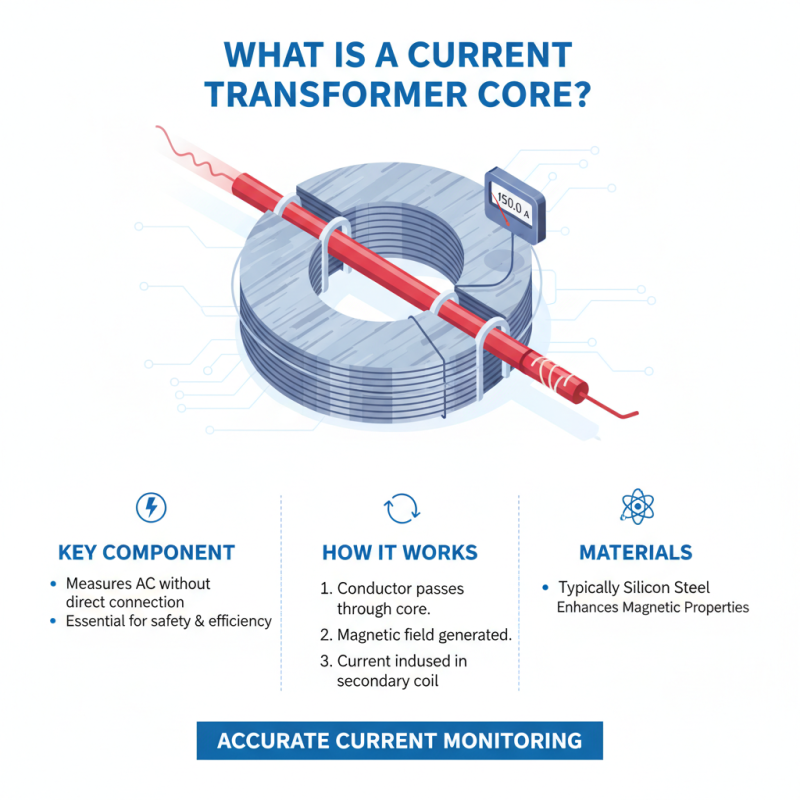
A current transformer core is a key component in electrical systems. It is used to measure alternating current (AC) in a conductor without directly connecting to the high-voltage circuit. The core is usually made from materials like silicon steel, which enhances its magnetic properties. These transformers provide an accurate means to monitor the current flow, which is essential for safety and efficiency.
Understanding how the core functions is important. When current flows through the conductor, it creates a magnetic field. The transformer core captures this field, producing a secondary current proportional to the primary current. This accurate conversion allows for effective measurement and monitoring in various applications, such as protective relays and energy meters.
Tips: Ensure proper installation of the current transformer to avoid inaccuracies. Regular calibration of measuring equipment is crucial for maintaining reliability. Avoid excessive heat exposure, as it can degrade the core material.
Components of a Current Transformer Core
The core of a current transformer (CT) plays a crucial role in its functionality. Typically made of silicon steel, the core enhances magnetic properties and reduces energy loss. The efficiency of the core material significantly impacts overall performance. According to industry reports, the transformer’s core accounts for about 40% of its total losses.
Stray losses in the core arise from eddy currents and hysteresis. Designers must carefully choose the core materials and geometry to minimize these losses. Thin laminations or ferrite cores can help mitigate such losses, offering improved efficiency. Research shows that using high-quality magnetic materials can enhance the CT’s accuracy, ensuring precise readings in electrical systems.
The winding configuration also contributes to the effectiveness of the transformer core. The number of turns directly affects the transformation ratio, impacting the output current. An increase in turns increases sensitivity, but it can also lead to increased size and weight. Striking the right balance is crucial for practical applications.
Working Principle of Current Transformers
Current transformers (CTs) are essential in electrical systems, used primarily for measuring current. Their core plays a crucial role in their performance. The principle behind CTs is based on electromagnetic induction. When alternating current flows through the primary winding, it creates a magnetic flux in the core. This flux induces a proportional current in the secondary winding.
The core material directly impacts the efficiency of this process. High permeability materials enhance the magnetic link, minimizing energy loss. This means that even small currents can be transformed accurately. However, challenges may arise when the core becomes saturated. Saturation can lead to distorted readings and potentially affect system protection.
Understanding this concept helps improve the design and application of current transformers. Designers must balance core material, dimensions, and intended usage to ensure reliability. Even seasoned professionals can overlook these aspects. Regular testing and revisions of design can mitigate potential issues. Ultimately, knowing how a current transformer core functions deepens one's grasp of electrical measurement systems.
Applications of Current Transformer Cores
Current transformer cores play a crucial role in various industrial applications. They are widely utilized in power monitoring systems and energy management. According to a report by Mordor Intelligence, the global current transformer market is expected to grow by over 6% annually through 2027. This growth highlights their importance in modern electrical systems.
In power generation, current transformers help ensure accurate measurements for load balancing. This accuracy is vital for preventing overloads, which can lead to equipment failure. Research from the International Energy Agency indicates that effective energy management can reduce operational costs by 15-30%. Current transformers also serve in renewable energy applications, such as solar power systems, enabling better grid connection and efficiency.
While current transformer cores are reliable, they have limitations. Temperature variations can impact their performance and accuracy. Additionally, the choice of core material affects sensitivity and response time. These factors necessitate careful consideration during design and installation. This ongoing need for improvement reveals that industry standards are continuously evolving.
Benefits of Using Current Transformers in Electrical Systems
Current transformers (CTs) play a crucial role in electrical systems. They measure high currents accurately and transform them into lower values for safe monitoring. This process enhances safety and efficiency in managing electrical loads.
One major benefit of using current transformers is their ability to enhance measurement accuracy. According to a 2022 report by the International Electrotechnical Commission, using CTs can improve measurement precision by about 3-5%. This small percentage can lead to significant improvements in energy management. Additionally, CTs can help detect overcurrent conditions quickly, preventing potential damages.
Tips: Regularly calibrate your current transformers to ensure accuracy. Incorrect calibration can lead to serious operational issues.
CTs also contribute to energy efficiency. A study from the Energy Efficiency Institute highlighted that integrating CTs in electrical networks can improve energy consumption tracking by almost 15%. This leads to better load management and cost savings. Assessing the right sizing of CTs is crucial. Oversized or undersized transformers can lead to misleading data.
Tips: Always consider the load requirements when choosing a current transformer. Misunderstanding load profiles can result in incorrect decisions.
Enhancing protection schemes is another notable advantage. By utilizing CTs, utilities can implement more effective protection mechanisms. This can reduce fault conditions and improve system reliability. However, it's essential to continuously evaluate transformer performance. Unnoticed degradation over time can lead to system vulnerabilities.