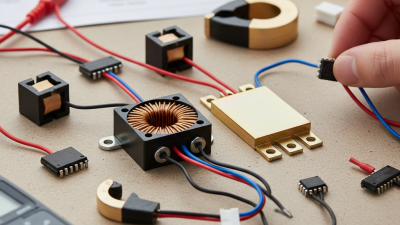
Top Current Sensor Types You Should Know About?
In today's rapidly evolving electronics landscape, understanding the various types of Current Sensors is crucial. Renowned expert Dr. Emily R. Stanford, a leader in sensor technology, states, "Current sensors are the backbone of modern electrical monitoring systems." Her insight emphasizes the necessity of these devices in numerous applications.
Current Sensors come in various forms, including hall-effect, shunt, and current transformer sensors. Each type has unique advantages tailored to different scenarios. For example, hall-effect sensors are ideal for non-intrusive measurements, while shunt resistors are favored for precision tasks.
While exploring the different types, it’s important to recognize their limitations. Current sensors can be costly and require proper calibration for accurate readings. An understanding of these complexities can enhance reliability in electrical applications. As technology advances, awareness of Current Sensor types empowers designers and engineers to make informed decisions.
Types of Current Sensors: An Overview of Options Available
Current sensors play a critical role in various applications. They help monitor electrical currents effectively. Understanding the types of current sensors available can enhance system efficiency.
Two main types are hall effect sensors and shunt resistors. According to a recent market report, the hall effect sensor market is expected to reach $5.2 billion by 2027. This growth is driven by their accuracy and versatility.
Hall effect sensors use magnetic fields to measure current. They require minimal invasive actions. Shunt resistors, on the other hand, measure voltage drop across a resistor. These sensors are often low-cost, making them popular in automotive applications. However, they can introduce heat in a circuit, which may lead to errors if not managed properly.
Another type is the current transformer (CT). It is used in high-voltage systems. Current transformers provide electrical isolation. Estimates show the global CT market will grow substantially over the next five years, highlighting their demand. Despite their advantages, CTs can have limitations regarding frequency response. Understanding these nuances is essential for selecting the appropriate sensor for your project. This diversity in current sensors opens opportunities but also requires careful consideration.
How Hall Effect Sensors Function in Current Measurement
Hall Effect sensors have gained significant traction in current measurement due to their unique operational principles. These sensors utilize the Hall effect, which occurs when a magnetic field interacts with current flow. When a conductor carries current through a magnetic field, a voltage—referred to as the Hall voltage—is generated perpendicular to both the current and the magnetic field. This phenomenon allows for accurate and non-invasive measurement of current levels in various applications.
According to recent industry data, Hall Effect sensors are about 30% more efficient in current sensing than traditional shunt resistors. This reflects their growing preference in industries that require precision. The ability to measure both AC and DC currents adds to their versatility. They can be found in electric vehicles, renewable energy systems, and electric motor control.
However, challenges remain. Environmental conditions can affect their performance, especially in extreme temperatures. Companies are encouraged to invest in calibration and testing to ensure reliability. While Hall Effect sensors continue to improve, the industry must address such limitations to fully harness their potential in current measurement applications.
The Role of Current Shunt Resistors in Electrical Applications
Current shunt resistors play a vital role in electrical applications. They measure current flow by producing a small voltage drop proportional to the current. This allows for accurate monitoring and control of electrical systems. Shunt resistors are used in various fields, including automotive, industrial, and consumer electronics. Their reliability makes them essential for precise measurements.
When selecting a shunt resistor, consider its resistance value and power rating. Too low of a resistance can lead to inaccuracies. Conversely, a high resistance may cause excessive power loss. Always ensure the resistor can handle the required current load. It's crucial to match the shunt resistor with the sensor to achieve optimal performance.
Tip: Use a thermal sensor to monitor the temperature of the shunt resistor. Excessive heat can affect accuracy and reliability.
Tip: Test the system under different conditions to identify potential weaknesses. Regular testing can help catch issues early.
Shunt resistors aren't without challenges. They can introduce noise and require proper filtering for accurate readings. Additionally, their placement in a circuit needs careful consideration. Poor placement can lead to measurement errors. Understanding these nuances will enhance your electrical projects significantly.
Transformers as Current Sensors: Principles and Use Cases
Transformers serve as vital tools in electrical engineering, particularly as current sensors. They operate on the principle of electromagnetic induction. When alternating current flows through the primary winding, it generates a magnetic field. This field induces a current in the secondary winding, allowing measurement of the primary current indirectly.
Their use cases extend widely across industries. In power distribution systems, transformers monitor load levels and enhance safety. They help detect overload conditions, providing critical data to prevent failures. Additionally, in renewable energy setups, they facilitate the integration of various energy sources by enabling smooth current measurement.
Despite their extensive use, challenges exist with transformer accuracy. They may have limitations in measuring very low currents. Users must be cautious about sensor calibration. Regular maintenance is essential to ensure reliability. Proper installation and selection of suitable transformers can significantly improve performance. Understanding these nuances can lead to better and more efficient applications of transformers in current sensing.
Current Sensor Types Comparison
Advantages and Limitations of Different Current Sensor Types
Current sensors play a vital role in various applications, from industrial machinery to renewable energy systems. Understanding their advantages and limitations can help engineers make informed decisions. Hall effect sensors, for instance, offer high accuracy and non-intrusive measurements. They are capable of measuring both AC and DC currents. However, they can be affected by external magnetic fields, impacting accuracy in certain environments.
Another common type is the shunt resistor. Shunt resistors are known for their simplicity and low cost. They deliver precise readings and are often used in battery management systems. Yet, their main drawback is power loss due to heat. This can lead to inefficiencies, particularly in high-current applications. A report by Grand View Research estimates that the global market for current sensors is expected to reach $3.4 billion by 2025, highlighting the importance of these technologies.
Rogowski coils are versatile and lightweight options. They can measure high AC currents without needing direct contact. Their primary limitation is the need for signal conditioning, which can complicate implementation. In contrast, current transformers are reliable for high-voltage applications. However, they are bulky and less effective for smaller currents, showing the nuanced nature of selecting the right sensor for specific tasks. Understanding these trade-offs is essential for optimizing performance in any current measurement system.
Top Current Sensor Types You Should Know About
| Current Sensor Type |
Advantages |
Limitations |
| Hall Effect Sensor |
Non-intrusive, high accuracy, can measure AC and DC. |
Expensive, sensitive to external magnetic fields. |
| Shunt Resistor |
Low cost, high accuracy for DC measurements. |
Power loss in resistor, not suitable for high voltage. |
| Rogowski Coil |
Flexible, can measure large currents without saturation. |
Requires integration for AC measurements, less accurate at low frequencies. |
| Current Transformer (CT) |
Widely used for AC, high isolation, simple to integrate. |
Cannot measure DC, bulky design. |
| Capacitive Current Sensor |
Compact size, good for low-current applications. |
Limited to AC measurements, not suitable for high current. |