
Leave Your Message
Distribution transformers rarely attract attention until a neighborhood feeder overloads, a factory adds equipment, or a storm knocks out service. Yet rising electricity use is increasing pressure on the equipment that steps voltage down for homes and businesses. The International Energy Agency’s Electricity 2024 report projected global electricity demand would grow by an average of 3.4% annually from 2024 to 2026. That forecast does not measure transformer sales directly, but it signals why utilities are reviewing capacity, replacement schedules, and resilience.
The U.S. Department of Energy’s 2022 National Transformer Supply Chain Deep Dive Assessment examines manufacturing, materials, and supply-chain challenges. Its findings matter when comparing a compact pad-mounted unit beside a sidewalk with a pole-mounted transformer serving a rural road. These familiar designs are only part of the picture. Oil-immersed units often suit outdoor distribution, while dry-type models are common inside buildings where fire-safety and installation needs differ. Smart monitoring can also be added to some designs; it is a feature, not a separate core construction type.
This guide compares the leading Distribution Transformer types expected to remain relevant in 2026, including their typical applications, strengths, and trade-offs. Selection depends on load, location, climate, maintenance capacity, and applicable standards—not on one “best” category. Details matter. A specification that looks efficient on paper may be less practical when space is tight or replacement parts are delayed. That is worth considering. Industry forecasts are useful, but local project data should guide final decisions.
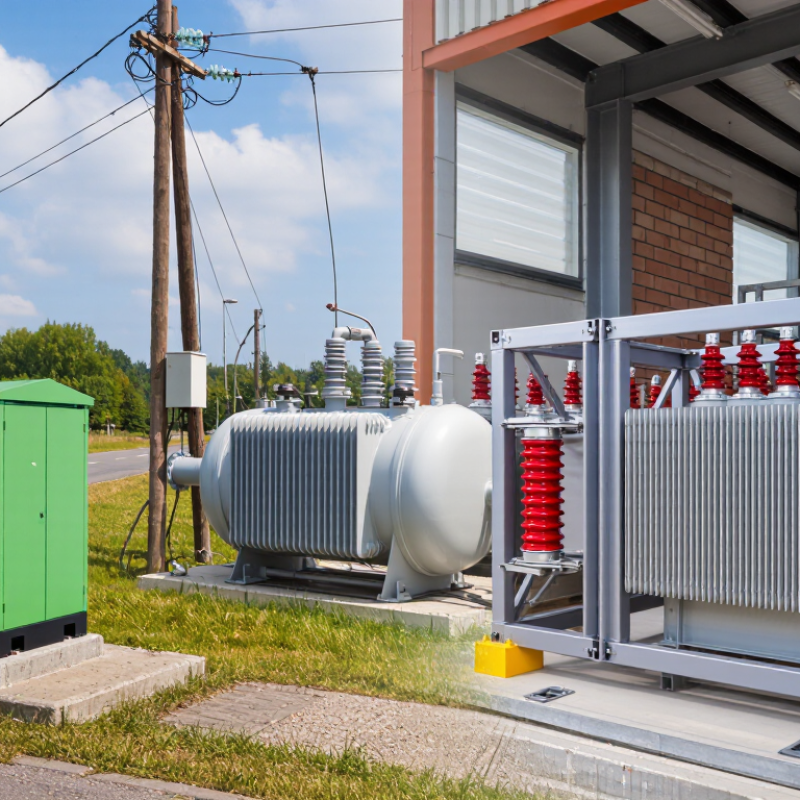
Distribution transformers make electricity usable close to where it is consumed. They reduce medium-voltage power to levels suitable for homes, shops, schools, and small industries. That sounds simple. It isn’t. A unit must handle changing demand while keeping voltage steady and limiting energy losses. In 2026, this role matters even more as electric vehicles, heat pumps, and rooftop solar add new patterns to local grids.
A transformer near a busy street may face sharp evening peaks, while one serving a rural area may need to cover longer distances between customers. Engineers consider expected load, installation space, climate, maintenance access, and future expansion before choosing equipment. Liquid-filled units are common outdoors, while dry-type designs can suit indoor locations where fire risk and ventilation need careful attention. These are broad patterns, not fixed rules. A dry-type unit is not automatically the safer or better choice in every building.
Distribution transformers also support local resilience, but they cannot solve every grid problem. Poor load estimates can leave equipment undersized; excessive spare capacity can add unnecessary cost and losses. Planning depends on real operating data, and that data is not always complete. Regular inspections and temperature monitoring help operators spot trouble early, though monitoring cannot replace sound design or maintenance.
| Transformer type | Basic design | Typical applications | Key advantages | Important considerations |
|---|---|---|---|---|
| Oil-immersed, pole-mounted | Core and windings are immersed in insulating liquid; the unit is mounted on a utility pole. | Overhead distribution networks serving rural areas, streets, and individual buildings. | Compact installation above ground; suitable for supplying local loads from overhead lines. | Requires suitable pole structures, safe access controls, and attention to liquid containment and fire protection requirements. |
| Oil-immersed, pad-mounted | Liquid-filled transformer in a locked, ground-level enclosure, commonly designed for underground cable connections. | Residential subdivisions, commercial sites, campuses, and underground distribution systems. | Ground-level placement and enclosed connections can support streetscapes where overhead equipment is undesirable. | Needs clear working space, secure placement, and compliance with local electrical, fire, and environmental rules. |
| Oil-immersed, vault-type | Transformer installed in an underground or indoor vault, with ventilation and access provisions suited to the site. | Dense urban districts and locations with underground networks and limited surface space. | Keeps much of the equipment out of sight and can serve loads close to the point of use. | Vaults require careful planning for heat removal, water ingress, safe access, and fire protection. |
| Dry-type, ventilated | Windings are insulated with solid materials and cooled by air; no insulating liquid is used. | Indoor commercial buildings, schools, hospitals, and industrial facilities. | Avoids insulating-liquid leaks and is often suited to indoor installations when properly selected and installed. | Needs adequate ventilation and protection from dust, moisture, and other site conditions that could affect insulation or cooling. |
| Cast-resin dry-type | Windings, typically the high-voltage windings, are encapsulated in solid resin; cooling is generally by air. | Indoor locations where reduced liquid-related risk or resistance to certain environmental conditions is a priority. | Solid insulation can provide robust protection against moisture and contamination when matched to the installation environment. | Initial cost, heat dissipation, and environmental suitability should be assessed for the specific site and duty cycle. |
| Single-phase distribution | Designed for single-phase supply; commonly installed as an individual unit or as part of a bank. | Homes, small businesses, and other loads served by single-phase circuits, depending on the distribution system. | Can match the needs of smaller or predominantly single-phase loads. | Selection must account for the supply arrangement, connected load, voltage, and local utility practice. |
| Three-phase distribution | Uses three-phase windings to transfer power between primary and secondary three-phase systems. | Commercial buildings, industrial facilities, and areas with substantial three-phase demand. | Provides three-phase power for motors and other balanced or three-phase loads through one transformer unit. | Capacity, winding connection, voltage regulation, and fault protection must be coordinated with the network and loads. |
Note: Mounting arrangement, insulation medium, cooling method, and phase configuration are different ways to classify distribution transformers. Available ratings and specifications vary by utility requirements, national standards, and installation conditions.